Magnets, Penny, Zinc, Nickel, Iron, Steel, Copper - If you have ever played with magnets, you know that they attract iron, steel and some other metals. But what about money?
These experiments are from Robert Krampf - The Happy Scientist
This week's experiment is the result of a teacher asking for experiments with
magnets. If you have ever played with magnets, you know that they attract
iron, steel and some other metals. But what about money? To try this, you
will need:
a fairly strong magnet
a variety of money
I used US money, but it would be interesting to try money from other
countries. Start with a penny. Bring it near a strong magnet (I tested all
of the magnets on our refrigerator door and selected the one that would lift
the most weight.) Does it stick? No. The composition of US pennies has
varied, but they are currently made of zinc and copper, neither of which is
attracted to a magnet. In 1943, they were made of steel, so if you are lucky
enough to have one of these, it would be attracted to the magnet. It would
also be a collector's item, so take good care of it.
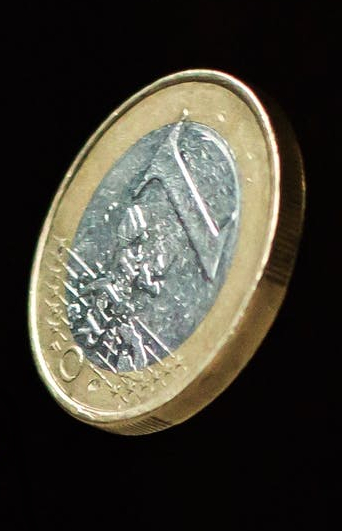
Next, try a nickel. It should stick, right? Nickel is a magnetic metal,
just like iron. Try it and see what happens. If it is a US nickel, it does
not stick. Even though we call them nickels, US nickels do not contain
enough nickel metal to make them magnetic. Other countries have coins that
will attract a magnet, so if you live outside the US, check carefully.
Keep working your way through the coins. In the US, you will not find any
coins that attract a magnet, but don't give up yet. Once you are finished
with the coins, it is time to try the bills. Bills? They are made of paper,
and anyone that has ever played with magnets knows that they do not attract
paper. Still, to be scientific, we should test it. We want the bill to be
hanging freely, so that it will be easy to see if it is attracted to the
magnet. I accomplished this by closing one corner of the bill in the bottom
of the door to our kitchen cabinet. This left the bill hanging down. Bring
the magnet close to the bill. Pick a place on the bill that has lots of ink.
What happens? It sticks! The bill is actually pulled towards the magnet
and sticks! Why?
United States bills are printed with magnetic ink. This magnetic ink is what
attracts the magnet. Why is the ink magnetic? It is a way to detect
counterfeit bills, helping mechanical bill changers detect fakes. They also
use the patterns of magnetic ink to tell if a bill is a $1, $5, $10, etc.
That helps prevent people from "making money" with a copy machine. Since
they do not print with the special, magnetic ink, the copy would be
identified as counterfeit.
If you run into problems, your magnet is probably not strong enough. Avoid
the rubberized, flat magnets, as they are not strong enough. You can get
very powerful, rare earth magnets from Radio Shack and electronic supply
stores. If you still can't get your $100 bills to stick to the magnet, feel
free to send them to me for further testing.
Free printables for multiplication, roman numerals, state capitals, parts of speech, and more.
Math exercises. Multiplication and roman numeral resources. Posters, charts, converters.
Quizzes including world capitals, presidents in order, the elements, state flags, and more.
Armour, castle games, recipes, quizzes, fashions, music, old world maps, medicine, and more.
Alphabet flash cards, printable high frequency words, and printable parts of speech chart.
Spanish numbers to 20 and the Korean alphabet. Printable flash cards and charts.
Science games and quizzes, posters, science experiments.
Free Experiment of the Week from Robert Kramp's Science Education Co.
Posters, printables, the Lifeboat Game, fifty states resources, quizzes.
Reading systems, flashcard, worksheet and test makers, game creators, percentage calculator, timeline template.
Grade school and accredited high school, online public schools, foundational phonics, more.
Stickfigure animations, build a web page and a website template for kids.
Printable guitar and keyboard charts, ukelele chords diagram.
Free books, posters, videos, software, kits, curriculum, courses.
We're finding the good out there and sharing it.
Easy extra money! Lots of info here.
Food intolerance, night flying wasps, and more.
Maille armor pictures, ninja and camouflage pictures, and more.
If you have comments, questions, or would like to report a broken link, please send an email to Cheryl at byclc@live.com
© 2000-2024 Nicholas Academy
site map | privacy policy | by CLC | Micro-Ways