Saliva, Salivary Glands, Mucus Membrane, Glucose - This week's experiment comes from our cat, Mawra. She is a delightful cat, but when she is very happy, she drools.
These experiments are from Robert Krampf - The Happy Scientist
This week's experiment comes from our cat, Mawra. She is a delightful cat,
but when she is very happy, she drools. She was happily sitting in my lap
while I was thinking of topics for this week's experiment. That's when it
hit me. (Literally) Saliva! To learn more about spit, you will need:
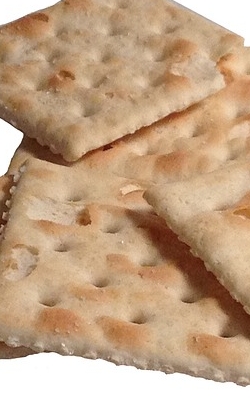
a saltine cracker
If you don't have a plain saltine, you can use a piece of bread. First, rub
all the salt off the cracker. We are trying to taste a very faint flavor,
and the salt will overpower it.
Once you have removed the salt, put the cracker in your mouth and start
chewing. Pay close attention to the taste. Very crackery, right? Now
comes the hard part. Do not swallow the cracker. Just keep chewing and
chewing. I found that it helps to pretend that it is chewing gum. Pay
close attention to the flavor. After a minute or two of chewing, you should
start to notice a slight sweet taste. The longer you chew it; the sweeter
it will taste. It will not taste as sweet as candy by a long shot, but you
should get enough sweetness to detect.
Why does the cracker begin to taste sweet? It has to do with your saliva.
Saliva is the scientific term for spit, and it is very useful stuff. When
you eat, your saliva moistens your food to help it go down easier, but it
does more than just that. It contains an enzyme called amylase. Amylase
changes the starch in your food into sugar. That is a good thing, because
the starch molecules are too large to pass through the membrane around your
cells. If it can't get into the cells of your body, it does not do you any
good. Amylase breaks the starch molecules apart into molecules of glucose.
Glucose is a kind of sugar, and its molecules are small enough to move
through the cell membrane so your body can use it.
Saliva really is interesting stuff. It comes from salivary glands located
in various parts of your mouth. It is about 99% water, with a little mucus
to make it slippery and a trace of Amylase. Even that tiny trace of amylase
can break down a lot of starch. If you have a jar of banana or sweet potato
baby food, put a drop of saliva into the jar and put it into the refrigerator
overnight. It needs to be a very starchy kind of food, not meat or green
vegetables. By the next day, the baby food will be pretty much liquefied.
The one drop of saliva digested the entire thing. Of course, you produce
more than a few drops of saliva. The average person produces and swallows 1
to 1.5 liters of spit per day. Think about that while you eat another
cracker. Have a great week.
Free printables for multiplication, roman numerals, state capitals, parts of speech, and more.
Math exercises. Multiplication and roman numeral resources. Posters, charts, converters.
Quizzes including world capitals, presidents in order, the elements, state flags, and more.
Armour, castle games, recipes, quizzes, fashions, music, old world maps, medicine, and more.
Alphabet flash cards, printable high frequency words, and printable parts of speech chart.
Spanish numbers to 20 and the Korean alphabet. Printable flash cards and charts.
Science games and quizzes, posters, science experiments.
Free Experiment of the Week from Robert Kramp's Science Education Co.
Posters, printables, the Lifeboat Game, fifty states resources, quizzes.
Reading systems, flashcard, worksheet and test makers, game creators, percentage calculator, timeline template.
Grade school and accredited high school, online public schools, foundational phonics, more.
Stickfigure animations, build a web page and a website template for kids.
Printable guitar and keyboard charts, ukelele chords diagram.
Free books, posters, videos, software, kits, curriculum, courses.
We're finding the good out there and sharing it.
Easy extra money! Lots of info here.
Food intolerance, night flying wasps, and more.
Maille armor pictures, ninja and camouflage pictures, and more.
If you have comments, questions, or would like to report a broken link, please send an email to Cheryl at byclc@live.com
© 2000-2024 Nicholas Academy
site map | privacy policy | by CLC | Micro-Ways